Trained for the Worst: How Military School Conditioning Produces Decision-Makers Who Thrive in Corporate Crisis
Photo: Northern Ireland Executive, OGL v1.0, via Wikimedia Commons
In the autumn of 2009, a mid-sized infrastructure firm operating across Southeast Asia faced simultaneous crises on three fronts: a financing collapse triggered by the global credit contraction, a regulatory investigation in one of its primary markets, and the abrupt departure of its chief operating officer. The board convened an emergency session and, after brief deliberation, elevated its head of strategy — a man who had spent his adolescence at a Sainik School in Rajasthan and his early adulthood as an officer in the Indian Army — to the executive chair.
Within eighteen months, the company had restructured its debt, resolved the regulatory matter, and posted its strongest revenue quarter on record. When asked afterward what had guided his approach during the worst of it, the executive's answer was characteristically understated: "I had been in harder situations at sixteen."
That response, and the instinct behind it, illuminates something important about how Sainik School training shapes the decision-making architecture of the men it produces — and why that architecture increasingly commands attention in corporate settings where the stakes are unforgiving.
The Psychology of Calibrated Risk
Conventional MBA curricula teach risk management as an analytical discipline. Students learn to build models, quantify probabilities, and construct decision trees. These are genuinely valuable tools, and the executives who wield them well have built impressive careers. But analytical frameworks, however sophisticated, are only as reliable as the human being applying them — and human beings, under genuine pressure, do not behave like spreadsheets.
What Sainik School training instills is something the models cannot capture: a visceral, experientially grounded comfort with adversity that fundamentally alters how the brain processes threat. Psychologists refer to this as "stress inoculation" — the phenomenon by which repeated, controlled exposure to high-pressure situations recalibrates the nervous system's baseline response to stress. Soldiers who have trained under simulated combat conditions respond more effectively to actual combat not because they are braver in any abstract sense, but because their threat-response circuitry has been trained to function rather than freeze.
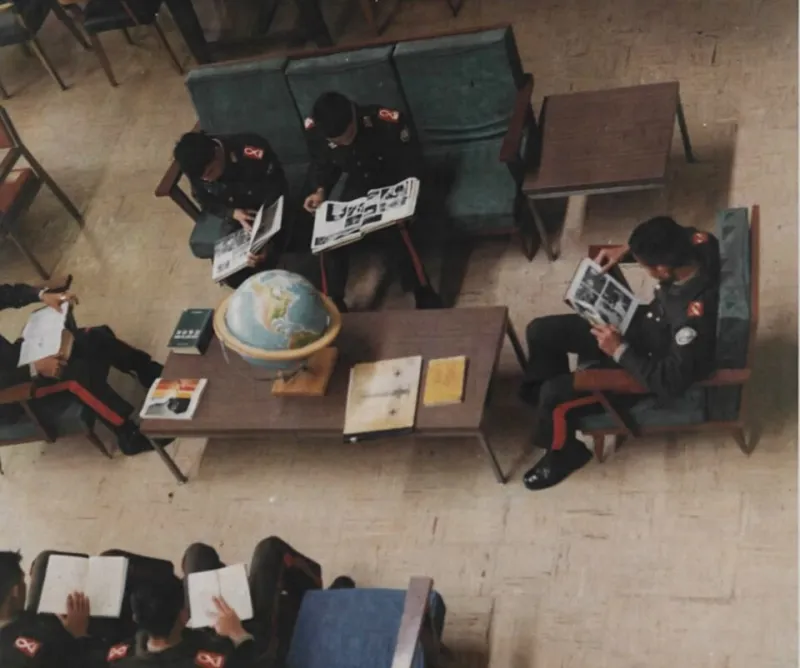
The adolescent years spent at a Sainik School are, in effect, a prolonged and intensive stress inoculation program. Cadets face physical demands, academic pressure, hierarchical accountability, and the particular psychological challenge of living far from family during the years when most of their peers enjoy the relative comfort of home. They learn, repeatedly and at an impressionable age, that discomfort is survivable — and that performance under discomfort is expected.
Case Study: Navigating a Strategic Pivot Under Fire
Consider the career arc of a Sainik School alumnus who rose to lead a major telecommunications company through the disruptive transition from legacy infrastructure to cloud-based service delivery. The company, heavily invested in physical network assets, faced a choice that many in the industry had deferred until deferral became impossible: cannibalize its existing revenue base by accelerating the shift to new technology, or protect short-term margins and risk catastrophic obsolescence.
Most executives in analogous positions delayed the decision, preferring the comfort of incremental adjustment to the vertigo of structural transformation. This alumnus moved decisively and early, absorbing two difficult fiscal years to position the company for what proved to be a dominant market position in the subsequent period.
When analysts later examined the decision, they noted something beyond the strategic logic: the speed and confidence with which it was executed, despite substantial internal opposition and external skepticism. Those who had worked with him attributed this to a characteristic they struggled to name precisely but consistently described in similar terms — a fundamental absence of panic, even when panic might have seemed the rational response.
This is not a personality quirk. It is a trained capacity.
The Decisive Variable: Comfort With Incomplete Information
One of the most consequential differences between executives trained in military environments and those trained exclusively in academic or corporate ones is their relationship with incomplete information. Academic and corporate training, almost by definition, rewards the comprehensive analysis — the fully sourced argument, the exhaustively modeled scenario. The implicit message is that better decisions follow from more information, and that uncertainty is a problem to be solved before action is taken.
Military training operates on a fundamentally different premise: that action under uncertainty is not a failure condition but the normal operating environment. Officers are trained to make sound decisions with whatever information is available, to act on incomplete intelligence when delay carries its own costs, and to remain adaptable when the situation changes after the decision has been executed.
Sainik School alumni who have gone on to corporate leadership consistently demonstrate this orientation. They are not reckless — the discipline of their training works against recklessness — but they are notably unparalyzed by ambiguity. In organizational environments where decision paralysis is endemic, this quality is not merely useful. It is differentiating.
What the Data Suggests
While rigorous longitudinal studies comparing military-school-trained executives to their conventionally educated peers remain limited, the available evidence is instructive. Research on military veterans in corporate leadership roles consistently finds higher performance on dimensions including crisis response, team cohesion under pressure, and the ability to maintain strategic clarity during operational turbulence. Sainik School alumni, who combine military training with elite academic preparation and strong professional networks, represent a particularly concentrated expression of these traits.
Several American firms that have deliberately recruited Sainik School alumni into senior roles — particularly in sectors characterized by high operational complexity and significant regulatory exposure — report measurably different decision-making patterns: faster escalation of emerging problems, greater willingness to accept short-term costs for structural benefit, and a cultural influence on surrounding teams that tends to reduce the organizational anxiety that often precedes poor decisions.
The Institutional Lesson
For American organizations grappling with a leadership pipeline that often produces technically proficient but psychologically brittle executives, the Sainik School model offers a pointed lesson. The qualities that distinguish great crisis leaders are not primarily cognitive. They are dispositional — products of formation, not instruction.
You cannot teach comfort with adversity in a seminar. You cannot instill calibrated risk appetite through a case study. These capacities are developed through years of structured challenge, repeated exposure to consequence, and the gradual internalization of a standard that demands performance regardless of circumstance.
America's military academies understand this. So do the best athletic programs, the most demanding professional training pipelines, and a small number of corporate cultures that have deliberately built adversity into their development processes. The Sainik School system has understood it for generations.
The executives it produces do not merely manage crises. They were built for them.