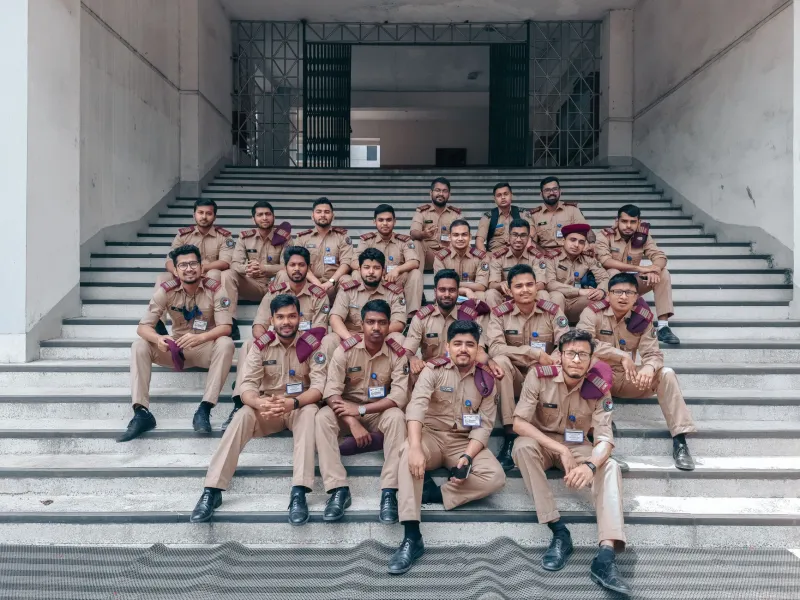
Unspoken Authority: The Silent Signals That Set Sainik School Graduates Apart in Any Room

There is a moment that veteran recruiters describe with surprising consistency. A candidate walks into the room — or joins the video call — and before a single qualification is stated, something registers. The posture is deliberate without being rigid. The eye contact is steady without veering into aggression. The pause before answering a question is measured, not anxious. These are not performance tricks learned from a coaching session. They are the residue of years spent inside one of India's most demanding institutional frameworks: the Sainik School system.
Across American corporate corridors, defense consulting firms, and technology companies with global operations, Sainik School alumni are earning a reputation that precedes their credentials. And increasingly, the people doing the hiring are trying to name what they are responding to.
The Posture of Accountability
Military educators have long understood that physical comportment is not merely aesthetic — it is functional. At Sainik Schools, cadets are trained from early adolescence to occupy space with intention. Slouching is not simply discouraged; it is treated as an expression of disengagement, a signal that one has mentally left the room. This conditioning produces adults who, decades later, carry themselves in ways that communicate readiness and presence.
In American professional environments, where casual body language has become the cultural norm — particularly in startup culture and remote-work settings — this contrast is striking. Hiring managers at firms ranging from defense contractors in Northern Virginia to financial institutions on the East Coast have noted that Sainik School alumni tend to project what one senior talent director described as "gravitational competence." They seem to understand, instinctively, that how one occupies a space shapes how one is perceived within it.
This is not arrogance. It is the quiet confidence of someone who has been held accountable, at scale, for extended periods of time.
Ambiguity as a Test, Not a Threat
One of the most revealing behavioral markers surfaces not in moments of clarity, but in moments of uncertainty. In an era of rapid organizational change, ambiguity is the defining condition of professional life. How an individual responds to incomplete information, shifting priorities, or contradictory directives reveals more about their formation than any curated LinkedIn profile ever could.
Sainik School graduates, by nearly universal account from those who work alongside them, treat ambiguity as a problem to be structured — not a condition to be lamented. This disposition is rooted in the schools' emphasis on mission clarity: cadets are trained to identify what is known, isolate what is unknown, and act decisively within that framework. The result is a professional who, when confronted with a chaotic situation, does not freeze or over-escalate. They orient themselves and move.
Recruiters conducting behavioral interviews have noted that Sainik School alumni tend to reframe ambiguous questions rather than deflect them. Where other candidates might hedge or offer vague generalities, these graduates parse the question, state their assumptions explicitly, and proceed with structured reasoning. It reads, to experienced interviewers, as intellectual confidence grounded in discipline — a combination that is genuinely rare.
The Hierarchy Paradox
American corporate culture has spent the better part of two decades dismantling traditional hierarchies in favor of flat organizational structures, horizontal accountability, and the mythology of the "idea meritocracy." The results have been, at best, mixed. What has emerged in many organizations is not the absence of hierarchy but rather an informal, unacknowledged hierarchy that operates without the transparency or accountability structures of its formal predecessor.
Sainik School alumni navigate this landscape with a particular advantage. Their training has given them a sophisticated understanding of hierarchy — not as a system of blind obedience, but as a framework for coordinated action. They understand when to defer, when to advocate, and when to escalate. They know how to disagree with a superior in ways that are direct but not disruptive. They understand that institutional loyalty and personal integrity are not in conflict.
This produces professionals who are, paradoxically, both highly respectful of legitimate authority and remarkably difficult to manipulate through social pressure. They do not confuse seniority with correctness. They do not mistake loudness for leadership. In organizations where political maneuvering often masquerades as strategic thinking, this clarity of judgment is a rare and valuable asset.
Feedback as Information, Not Verdict
Perhaps the most commercially significant behavioral trait that Sainik School formation produces is a particular relationship with feedback. In environments where performance reviews are dreaded, where constructive criticism triggers defensiveness, and where many professionals conflate their work product with their identity, alumni of India's military schools stand apart.
From their earliest years in the system, Sainik School cadets receive feedback that is immediate, specific, and consequential. There is no softening of assessment, no bureaucratic delay between action and evaluation. This sustained exposure produces professionals who receive critical feedback without emotional collapse — who can absorb a difficult assessment, extract the actionable content, and apply it without requiring days of psychological recovery.
American managers who have supervised Sainik School graduates frequently remark on this quality, often using language that reveals how rare they find it. "He doesn't take it personally, but he takes it seriously," one operations director at a Washington, D.C.-area logistics firm told a colleague. That distinction — the capacity to internalize criticism without being destabilized by it — is among the most durable advantages the Sainik School system confers.
What Algorithms Cannot Capture
In the age of applicant tracking systems, keyword optimization, and AI-assisted resume screening, there is a growing recognition among senior talent professionals that the most consequential qualities of a candidate are precisely those that the algorithm cannot see. Character, composure, relational intelligence, and institutional trustworthiness do not parse into searchable fields.
This is the invisible resume — the behavioral record written not in bullet points but in bearing, in reflexes, in the accumulated habits of a formation that began before many American professionals had finished middle school. For Sainik School alumni, this invisible record is often more compelling than anything printed on paper.
The challenge, of course, is legibility. American employers who lack familiarity with the Sainik School system may not immediately recognize what they are encountering. The role of alumni networks — and institutions like Sainik School Society — is precisely to bridge that gap: to contextualize the formation, explain the framework, and ensure that the invisible resume is, in fact, read.
Because in a competitive professional landscape where everyone is optimizing their personal brand, the graduates who learned to lead before they learned to market themselves may hold the most durable advantage of all.