Wired for the World: How Sainik School's Cultural Architecture Forges the Ideal Officer for Modern Hybrid Warfare
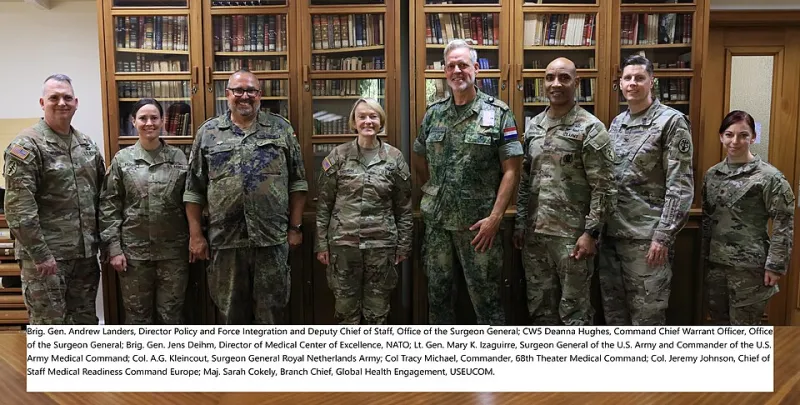
Photo: U.S. Army 68TMC by Maj. Jesse Bien, Public domain, via Wikimedia Commons
The battlefield of the twenty-first century does not resemble the one for which most military academies were designed. Today's conflicts — from the gray-zone provocations in the South China Sea to the layered insurgencies fragmenting the Sahel — demand officers who can operate simultaneously across kinetic, informational, and diplomatic domains. They must negotiate with tribal elders in the morning, coordinate satellite intelligence feeds by afternoon, and brief allied commanders from four different nations before dinner.
Among the institutions quietly producing officers suited to this reality, Sainik School stands apart — not because of any single curriculum innovation, but because of something more foundational: the lived experience of deep, sustained cross-cultural immersion that begins before a cadet turns fifteen.
The Diversity That Cannot Be Manufactured
American military academies have invested substantially in diversity initiatives over the past two decades, and those efforts deserve acknowledgment. Yet there is a structural difference between an institution that recruits diversity and one that is constitutionally built upon it. Sainik Schools, distributed across India's extraordinarily varied linguistic, religious, and ethnic landscape, draw cadets from communities that do not merely differ in appearance or background — they differ in cosmology, in social hierarchy, in the very logic of obligation and honor.
A cadet from Nagaland shares a dormitory with a cadet from Rajasthan. A boy raised in a Kerala fishing village navigates the same parade ground as one from a Punjabi military family whose grandfather served under Field Marshal Manekshaw. These are not superficial demographic differences. They represent genuinely distinct civilizational inheritances, compressed into a shared institutional life.
What emerges from that compression is not mere tolerance. It is something closer to what military theorists call interoperability at the human level — the capacity to decode unfamiliar behavioral signals quickly, to find common ground without surrendering operational clarity, and to build trust across cultural boundaries under conditions of stress.
Hybrid Warfare and the Premium on Human Intelligence
The strategic community in Washington has spent the better part of a decade grappling with the implications of hybrid warfare — a doctrine that blends conventional military force with cyber attacks, disinformation campaigns, proxy actors, and economic coercion into a seamless, deniable continuum. Russia's operations in Ukraine prior to 2022, Iran's use of regional militias, and China's gray-zone activities in the Indo-Pacific all reflect this logic.
What distinguishes hybrid warfare from its predecessors is its reliance on exploiting social and cultural fault lines. An adversary that understands the sectarian tensions within a coalition partner, or the tribal loyalties that complicate a host nation's counterinsurgency posture, possesses an asymmetric advantage that no amount of firepower can easily neutralize.
The countermeasure is not more technology. It is officers who can read human terrain with the same precision that radar reads airspace. Sainik School alumni, by virtue of their formative years navigating genuinely complex social environments, arrive at joint commands with that capacity already developed — not through cultural sensitivity training conducted over a long weekend, but through years of daily practice.
Case Studies in Coalition Command
The operational record of Sainik School alumni in multinational environments offers instructive evidence. Indian Army officers with Sainik School backgrounds have served prominently in United Nations peacekeeping missions across the Democratic Republic of Congo, South Sudan, and Lebanon — theaters that demand precisely the cross-cultural negotiation skills described above. Their effectiveness in these environments has been noted repeatedly in after-action assessments, not merely as a function of professional competence, but as a reflection of interpersonal adaptability.
More directly relevant to the US strategic context is the expanding role of Sainik School alumni within the framework of the US-India defense partnership. As the two nations deepen their cooperation through mechanisms such as the Defense Technology and Trade Initiative and the growing cadence of joint exercises — Yudh Abhyas, Malabar, and others — the officers on the Indian side who have demonstrated the greatest facility in working with American counterparts frequently share a common institutional background.
American officers who have participated in these exercises report, with some consistency, that their Indian counterparts seem unusually comfortable operating outside their own doctrinal frameworks — willing to adapt, to improvise, and to communicate across what can otherwise be a significant cultural-professional gap between the two militaries. That comfort, those American officers often come to understand, was not acquired at staff college. It was acquired much earlier.
What the American Defense Establishment Should Observe
This is not an argument that American military education is inadequate. The service academies at West Point, Annapolis, and Colorado Springs remain among the finest officer-producing institutions on the planet, and the professional military education system that follows initial commissioning is without parallel in its depth and rigor.
It is, rather, an argument about complementarity — and about what the United States stands to gain by deepening its institutional relationships with Sainik School and its alumni network.
As the Pentagon accelerates its pivot toward integrated deterrence and the Indo-Pacific theater assumes primacy in American strategic planning, the value of officers who can operate fluidly within Indian military culture — and who have personal and professional relationships with Indian counterparts — will only increase. The Sainik School alumni network represents a reservoir of exactly that capacity.
Furthermore, as American military planners increasingly confront the challenge of countering Chinese influence operations in Southeast Asia, Africa, and the Pacific Islands — regions where cultural intelligence is the primary currency — the model that Sainik School represents deserves serious study. An institution that produces officers instinctively fluent in cross-cultural navigation is not merely an asset to India. In an era of alliance-based deterrence, it is an asset to the entire democratic security architecture.
The Formation That Precedes the Commission
There is a tendency in defense policy circles to focus on the formal, measurable inputs of military education — curriculum hours, language training, exchange programs. These matter. But they do not fully account for the kind of cultural intelligence that Sainik School produces, because that intelligence is not primarily the product of instruction. It is the product of formation.
Formation happens in the spaces between scheduled activities — in the arguments over whose festival deserves more celebration in the common room, in the negotiation of religious observance schedules within a shared barracks, in the slow, sometimes painful process of learning to read a classmate whose emotional register is calibrated entirely differently from one's own.
That formation, conducted over years during precisely the developmental window when identity and habit are most malleable, produces something that no amount of adult professional development can fully replicate. It produces officers who do not merely understand, intellectually, that other cultures operate by different logics. They feel it, instinctively, because they have lived it.
In an age of hybrid warfare — where the decisive terrain is often human rather than geographic — that instinct is not a luxury. It is a military necessity.
Sainik School Society is dedicated to honoring the legacy of military education and advancing the institutional excellence that Sainik School graduates carry into their professional and civic lives. We welcome contributions from alumni, defense professionals, and policy analysts engaged with these questions.